


Demystifying the Open Water Swim
Imagine this: It's a chilly fall morning, the sun is barely up, and you are standing on the dock about to get in what looks like a very dark lake with semi-choppy water. You look toward the buoys and they seem so far away. The butterflies in your stomach are fluttering....
The open water can feel like a completely different sport than pool swimming. The pool gives you lane lines, clear water, walls, a black line on the bottom of the pool, and very predictable conditions. The lake or ocean gives you depth, darkness, cold, waves, limited visibility, and athletes on every side of you.
I’ve stood at the start of more than 100 races, and I can tell you this: open water fear is common. It does not mean you are unprepared. It means your brain is reacting to an uncertain environment.
The goal is not to pretend race day feels like the pool. The goal is to make the open water feel familiar enough that you can do your job which is to get through the swim.

Remind yourself that you have done the work.
Before the cannon goes off, your mind may try to convince you that the water is too deep, too dark, too cold, or too crowded. This is where you come back to truth.
You trained for this.
You swam when you were tired. You built fitness. You practiced breathing. You learned how to move through water. The race does not require a new version of you. It requires the same steady swimmer you built in training.
Say something simple to yourself like:
I have done the work for this race. I am a strong swimmer. I will take my time and stay relaxed, one buoy at a time.
That last sentence matters. Do not think about the full distance while standing on the shore. Think about the first few minutes. Then the first buoy. Then the next one.
Turn the lake or ocean into a pool in your mind.
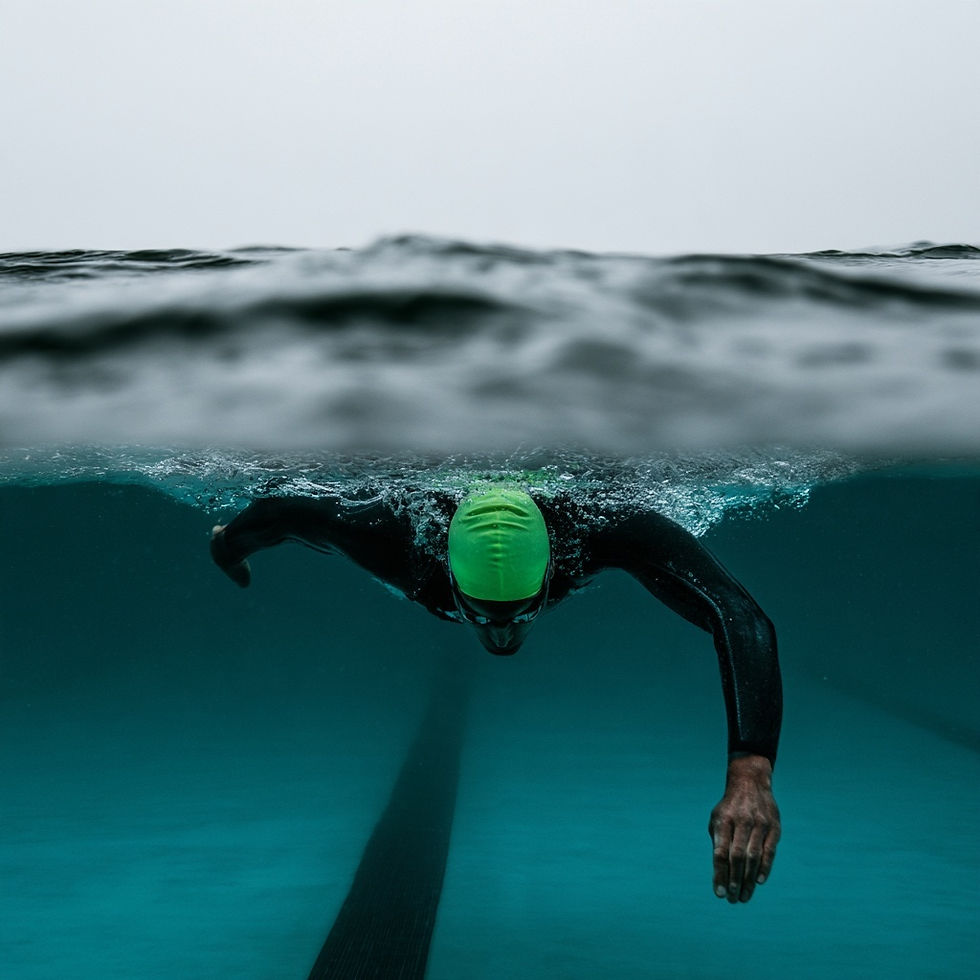
One of the best mental tricks is to shrink the water.
Instead of telling yourself, “This lake is huge,” imagine you are swimming in a pool that happens to be outside. Picture the bottom only 5 feet below you, even if it is much deeper. Your body does not swim differently because the water is deeper. Deep water does not pull you down. It holds you up the same way shallow water does.
The water may be darker. It may be colder. You may not see the bottom. But your stroke still works.
Your job is simple:
Put your face in the water
Exhale fully
Catch, pull, recover
Sight calmly
Keep moving forward
That is swimming. You already know how to do that.

Start slower than you think you should in the open water.
Most open water panic happens in the first few hundred yards. The heart rate spikes. The breathing gets short. Athletes bump into each other. The brain starts asking, “Can I really do this?”
This is why I want athletes to start controlled.
Not lazy. Not afraid. Controlled.
Let people surge if they want to surge. Let them sprint off the line. Your race is not won in the first 200 yards of the swim. If athletes pass you, let them go. Getting upset wastes energy and breaks your rhythm.
Start with smooth strokes and relaxed breathing. Find a clear path when you can. If you get bumped, keep your hands moving, reset your breath, and return to your pace.
Calm is faster than panic.
Break the swim into chunks.
The full swim distance can feel overwhelming if you carry the whole thing in your head. So don’t.
Use the buoys to break the course into smaller pieces. Maybe it is 300 yards to the first buoy, then another 300 yards to the next one. That is the race plan. Swim one section at a time.
Think of it like this:
First buoy
Second buoy
Turn buoy
Final stretch
Settle your breathing and stay relaxed
Lock into rhythm and hold your line
Stay calm in traffic and protect your space
Keep the stroke long and finish steady
You are not swimming 1.2 or 2.4 miles all at once. You are swimming buoy to buoy.
Stay in rhythm when things get messy.
Open water is not supposed to feel perfect. Someone may touch your feet. You may swallow water. A wave may hit you at the wrong time. You may look up and feel like the buoy has not moved any closer.
None of that means anything has gone wrong.
When the water gets messy, return to your rhythm. Count strokes if it helps. Breathe every two or three strokes, depending on what keeps you calm. Sight every few strokes, then put your head back down.
If fear rises, slow your kick and lengthen your exhale. Panic feeds on short breathing. A strong exhale tells your body, “We are okay.”
And you are okay.
Race the swim you trained for.
Open water rewards patience. The athlete who stays calm, swims straight, and keeps moving often beats the athlete who fights the water for the first half of the course.
Before race day, practice in safe open water when possible. Swim with others. Learn how your wetsuit feels. Practice sighting. Practice starting easy. If you can, rehearse the exact thought pattern you want on race morning.
The open water is deeper, darker, colder, and more crowded than the pool. But it is still water. You are still a swimmer. Trust your training, respect the conditions, and take the race one buoy at a time.
When swim start comes, keep it simple:
Slow start. Calm breath. Find rhythm. Next buoy. Repeat.

Have you thought about hiring a coach for your next iron distance event? Click the purple button below and fill out my short form. I will get back to you asap!
Mary Timoney
Ironman University Certified Coach
USA Triathlon Coach
ACSM Trainer


Comments